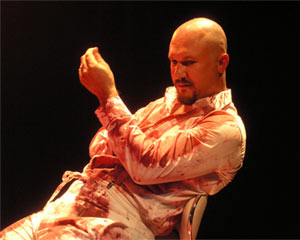
 In Richard III, Shakespeare has left us one of the greatest challenges to the willing suspension of disbelief ever created; Richard is a foul and loathsome character, and yet every time I see the play, I am amazed at how much sympathy I have for the detestable excuse for a human being I am presented with. Everyman Theatre has left me in this state yet again.
In their production, one of Canberra’s favourite actors, Duncan Ley, fills the title role admirably, engaging the audience accomplice-like in his fiendish plot to secure the throne. Ley’s beguiling and often sardonic engagement with the audience is helped along by the traverse arrangement of the stage, which leaves only two rows of audience on either side, and keeps everyone close to the megalomaniacal regent throughout.
It’s not only Richard who benefits from the traverse stage; other characters, often overshadowed by Richard’s dominance, are in this arrangement given space to stand rather more independently. Thus King Edward’s brothers are seen in rather a more individual light; his son, played with great humour by Peter Fock, connects strongly with the audience; and the women, often neglected as mere plot devices, are given space to stand their ground.
Indeed, the greatest strength of this production is Helen McFarlane’s portrayal of Queen Elizabeth. Her grieving, seething sarcasm, and her desperate acceptance of life’s injustices resonate with life like the sound of crushing metal in a car accident. This is a tribute not only to Helen’s performance, but also to the timeless exactitude of Shakespeare’s words. Elizabeth’s grief for her sons, and her fear for her daughter’s fate are expressed more eloquently and coherently than I have ever heard them before. This moment seems to steal the show, and rightfully so. While the climactic battle scene is usually foregrounded, this is done at the expense of the story’s lasting grit; which is the human suffering in the midst of political upheaval. In this production, Elizabeth seems to ground the story, keeping it human, when other productions I have seen have left her rather flat and one-dimensional.
With some very substantial omissions from Shakespeare’s text, and a few sprinklings of quite necessary backstory for the modern Australian audience, most of whom have not had the benefit of studying English history, director Duncan Driver has managed to distil quite a coherent story. I wondered, periodically, at the choice of music, which seemed at most times suited to the moment, but not necessarily having an overall consistency. This, I think, is a minor foible in the midst of a production that is otherwise well-balanced, well-humoured and at times very moving.
I don’t think I liked Richard III; which, ironically, is what makes it a good production. It is a play that should leave you at least a little bit uncomfortable, and for me, it did precisely that.
Everyman Theatre presents
Richard III
by William Shakespeare
Directed by Duncan Driver
Venue: The Courtyard Studio
Dates: 12 - 20 March, 2010
Times: Tuesday to Saturday @ 8pm
Tickets: $20/$15
Bookings: Canberra Ticketing 02 6275 2700 | www.canberratheatrecentre.com.au
Canberra Reviews
Richard III | Everyman Theatre
- Details
- Trevar Alan Chilver
Most read Canberra reviews
The Jungle and the Sea | Belvoir St Theatre
The Jungle and the Sea is one of the best pieces of theatre I have ever seen.
Diamond | Liz Lea
There are artists who make work, and there are artists who build communities. Liz Lea has spent more than three decades doing both.
Heathers the Musical
The cast is exceptional. The choreography is precise and beautifully executed. The lighting is gorgeous. The whole thing moves with extraordinary confidence and energy.
Mettle | Quantum Leap Australia
I left completely captivated. And actually shaking from the joy of the experience – for me that’s a sure sign of something great.
MOUNTAIN | Melanie Lane
MOUNTAIN is at its strongest in transformation: body into landscape, clothing into architecture, acoustic into electronic, individual into collective.